
Procurement as the Point Where Pressure Becomes Decision

How organisations live with pressure is shaped through procurement
Organisations operate under constant pressure from both the market and within. Price volatility, supply disruptions, technological change and regulatory shifts define the external environment, while capital constraints, demand variability, process efficiency and internal process quality shape the organisation’s ability to respond. Procurement sits at the point where these forces meet.
Its role is to determine how that pressure is managed and where its impact is felt within the organisation.
Procurement does not define the conditions in which it operates. It responds to them. External and internal forces converge in procurement and require decisions about how the organisation reacts. These decisions do not remove the situation. They define how it is handled and how its effects are distributed across the organisation.
The following model summarises how pressure is translated into decisions and outcomes.
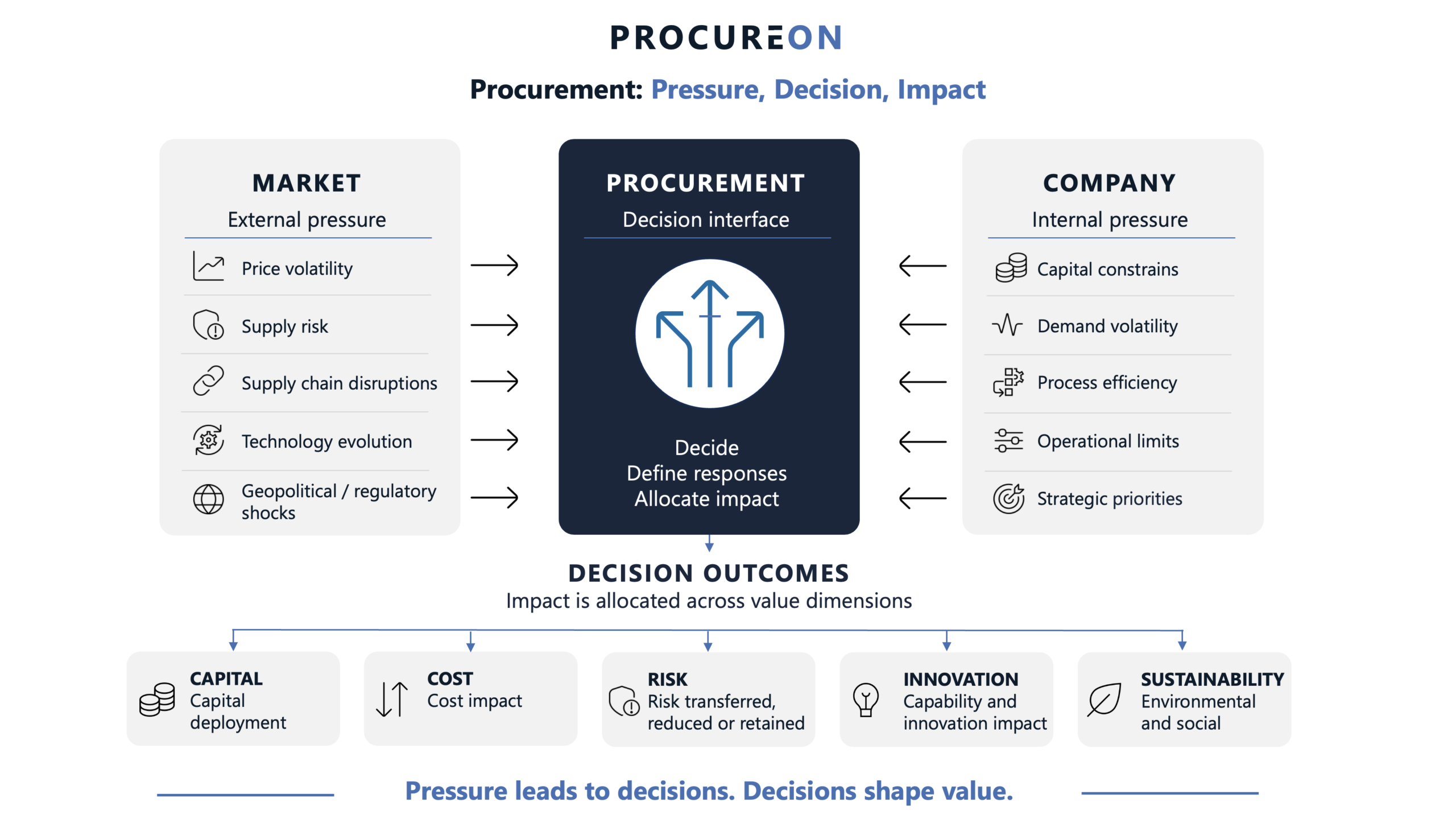
When disruption occurs, the response determines how the organisation experiences it. Increasing inventory shifts the impact into capital. Switching suppliers redistributes the impact across cost, risk and other dimensions, depending on the context. Maintaining the current setup transfers the impact into risk. The conditions remain the same. The outcome depends on how they are managed.
Evaluation often focuses on activities such as sourcing, negotiation or cost savings. These describe what procurement does, but they do not explain how decisions are made under pressure. What matters is how responses are chosen and how responsibility for their consequences is taken. Procurement translates external conditions and internal constraints into outcomes that shape capital use, cost structure, risk exposure and long-term performance.
When decisions are not made explicit, the effects accumulate over time. Risks are deferred, costs emerge later and capital becomes tied up without clarity. Short-term improvements create longer-term exposure, and the organisation experiences the consequences in different parts of the system. Procurement becomes the place where these effects surface.
A more accurate view recognises procurement as the point where pressure is resolved through decision. This requires visibility of choices, clarity of priorities and ownership of outcomes. Procurement connects external conditions with internal realities and translates both into decisions that define how the organisation operates under constraint.
Weak procurement reflects weaknesses in how decisions are made. Unclear priorities, fragmented responsibility and lack of ownership become visible at the point where pressure can no longer be avoided.
Procurement does not remove volatility. It translates it into decisions that determine how the organisation experiences it. Pressure is constant. What changes is how it is understood and managed.
Effective procurement focuses on understanding context, anticipating how pressure develops and acting in a way that limits unnecessary exposure while preserving the organisation’s ability to respond.
Procurement makes visible how the organisation chooses to live with pressure.
These ideas are developed further in Nabava kao ogledalo upravljanja, where procurement is examined as a reflection of how organisations make decisions and manage value.
